
I’ve seen a lot of impassioned conversations concerning hot water heat pumps in different internet forums, so it’s obvious to me that people care a lot about this seemingly unimportant topic.
The dialogues begin as follows:
Ask a harmless query about hot water.
Pin removal
Publish in a public energy forum
Grab cover!
Let’s agree that thermal storage is a cheap battery for your solar energy and that gas hot water belongs in the trash. This enables us to investigate the fundamental idea behind and benefits of the very effective heat pump hot water service.
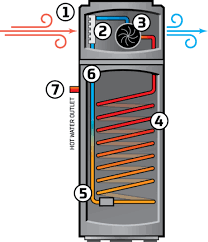
Contrary to popular belief, a substance known as refrigerant plays an essential role in a heat pump hot water system since it serves as the conduit for the transfer of heat from the air to the water. Heat from the surrounding air is absorbed by the refrigerant. The thermal energy in the air can be used, even in extremely cold temperatures.
Without the refrigerant, it would be impossible to collect and transport the embodied heat to the required location. It is odd because we don’t typically consider “cooling” materials to be important actors in heating water, but heat pumps require them to function properly.
One pitiful kW of power is sent into this mysterious contraption with refrigerant flowing through it, and presto! It produces 4 kW on the other end. Because you are not producing heat but rather utilizing it, the Coefficient Of Performance (COP) might be larger than 1 (1 = 100% efficiency).
Model, refrigerant type, work at hand, and ambient temperature are only a few of the variables that affect COP. But be cautious. As with the advertised range of an EV, you should read heat pump specifications with a healthy grain of skepticism because manufacturers occasionally overstate their numbers.

Condensation can be an issue if heat from the outdoors is drawn inside your home. It is possible for moisture to collect on your compressor unit, turning it ice solid like an unloved share house freezer when trying to extract 20oC of heat from air in winter, which is only 5oC above zero. Good heat pumps that are made to work in cold climates get past this. Ground-sourced heat pumps are another solution, but they are pricey and unpopular with us Australian cheapskates.
To get rid of bacteria like legionella, your hot water storage must be heated over 65°C daily1. Cheaper heat pumps employing R134a or R410a refrigerant can accomplish this in normal conditions, but they suffer in cold weather. Even though it uses less energy, manufacturers nevertheless include a conventional booster element as a safety net.
CO² and R290 (propane) are actually a lot more useful than anyone ever thought. While other refrigerants mentioned have a horrendous Global Warming Potential, literally 1430 or 2080 times worse for the climate than CO² when they escape, good old BBQ gas (propane) ranks as 0.02 GWP. It beggars belief that we’ve been paying the chemical industries for artificial refrigerants for so long.
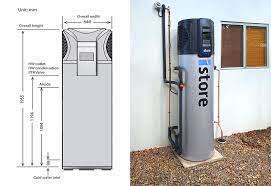
In fact, it sparked more than 130 comments. Recently, my colleague Kim Wainwright wrote a fantastic article on this topic that focused on the financial benefits of heat pumps. Here is some inside information from my friend Karl Jensen to further aggravate the situation and perhaps get your attention. In full disclosure, Karl is a wholesaler of iStore units2 but he is also an expert in the solar sector who frequently provides helpful guidance in a variety of media for no charge.
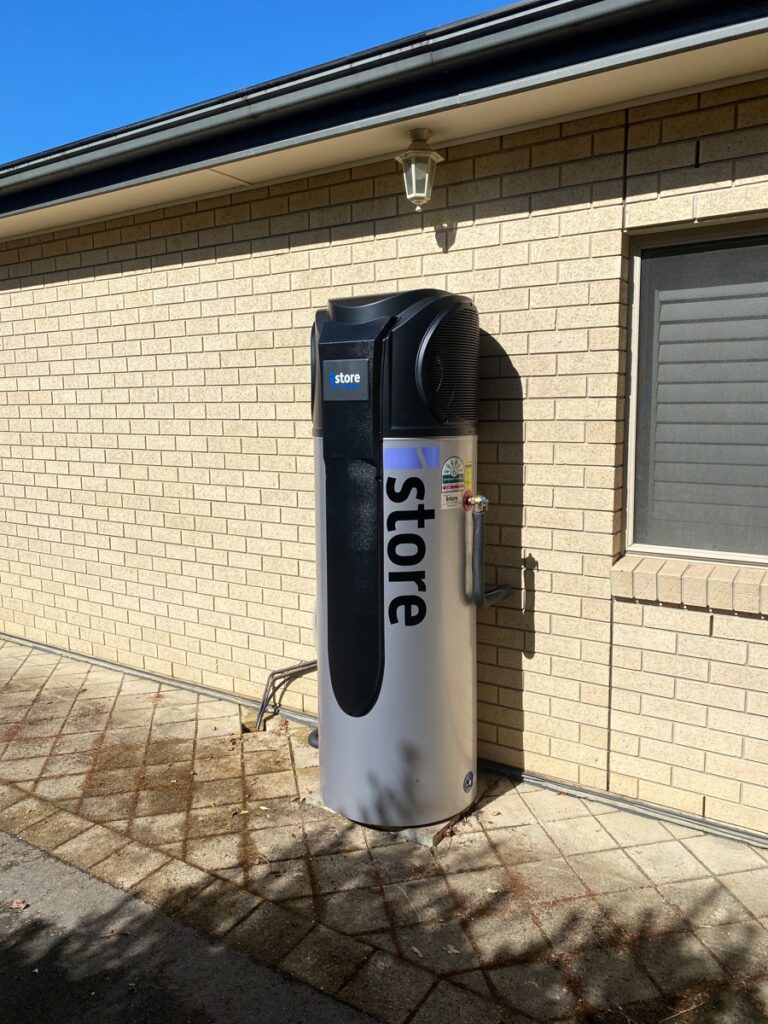
Water heater heating capability is determined under certain parameters, such as 15°C inlet water temperature and 32°C outside temperature. These figures are used by Rinnai’s enviroflow to support its claim of a 5.6 Coefficient of Performance (COP). However, these figures do not provide a complete picture, and some marketing may be deceptive.
In these circumstances, the 180L unit from iStore can achieve a COP of 6.85, but this is not the norm. As a result, iStore employs a more feasible COP of 4 that is more realistic. (Except in extremely cold conditions or right before the heating cycle ends)
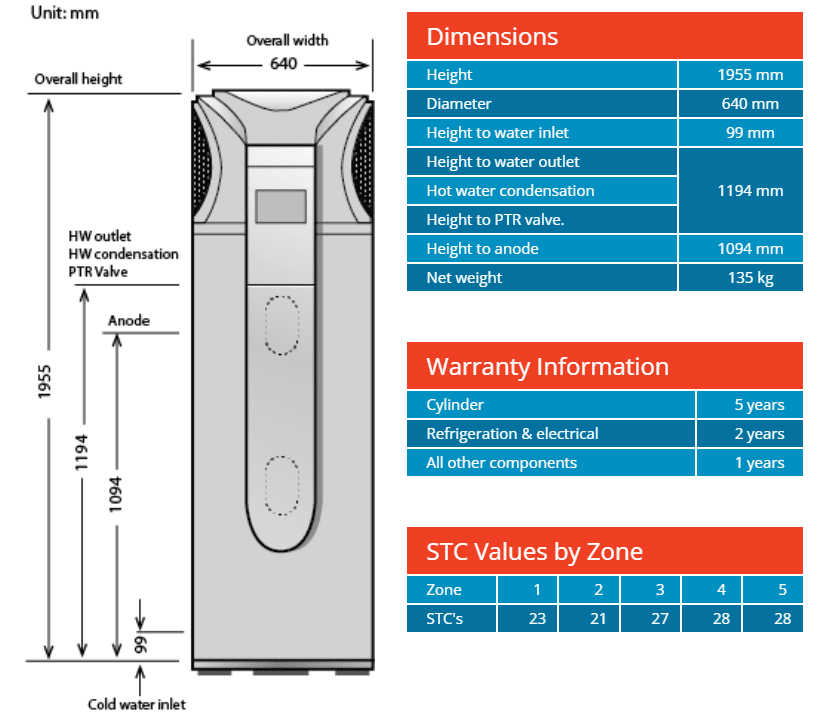
Small-scale Technology Certificates (STCs), which each unit obtains based on its climate zone, are what we need to look at in order to accurately assess performance.
For instance, iStore’s unit receives 25 STCs in Victoria. This indicates that for the course of the STC scheme’s 8-year lifetime, it will prevent 25,000 kg of CO2 emissions. Units Sanden and Reclaim receive 27 STCs, resulting in an additional 2,000 kg of CO2 avoided or 2,000 kWh of energy saved during the same time period. 200 liters of water require 0.68 kWh less energy per day to heat due to this difference.
The cost difference between the Sanden and iStore devices when using solar energy that you would otherwise transmit to the grid is roughly 3.4 cents per day. However, the Sanden machine typically costs $2,000 more than the iStore model. Therefore, it takes 161 years to make up the cost difference if you use solar energy. It also takes almost 20 years if you use grid power at a price of 28 cents per kWh.
Keep in mind that these figures are based on your water usage. The energy differential between the units is effectively cut in half if your household uses twice as much water as the average household
Heaters that resistive hot water consume a lot of energy. To maximize solar self-consumption, getting a smart hot-water PV diverter system to manage the heating element may make sense. But I’d say that you don’t need anything more complicated than a basic timer to control them since good heat pumps only use a fifth of the energy. Your heat pump’s power usage is probably inside the solar curve on all except the worst sun days. The good news is that reliable heat pumps have timers already installed.
You’re not the only one who is baffled by how much different units will cost. Key considerations in your decision-making process include heating capacity, CO2 emissions, energy use, and cost. Economic estimates can be considerably impacted by factors like household size, regional climate, water usage (dare I say, the number of daughters?) and if you’re using solar or grid power. In fact, there is a spreadsheet here that compares if you enjoy spreadsheets.
Empowering Australians to Save on Hot Water Heat Pumps since 2008 – a Decade of Efficiency and Innovation.